
This guide explains how administrative rules move from publication through public comment, committee review, and final adoption.
Use the sections below to expand and collapse details about each part of the rulemaking process.
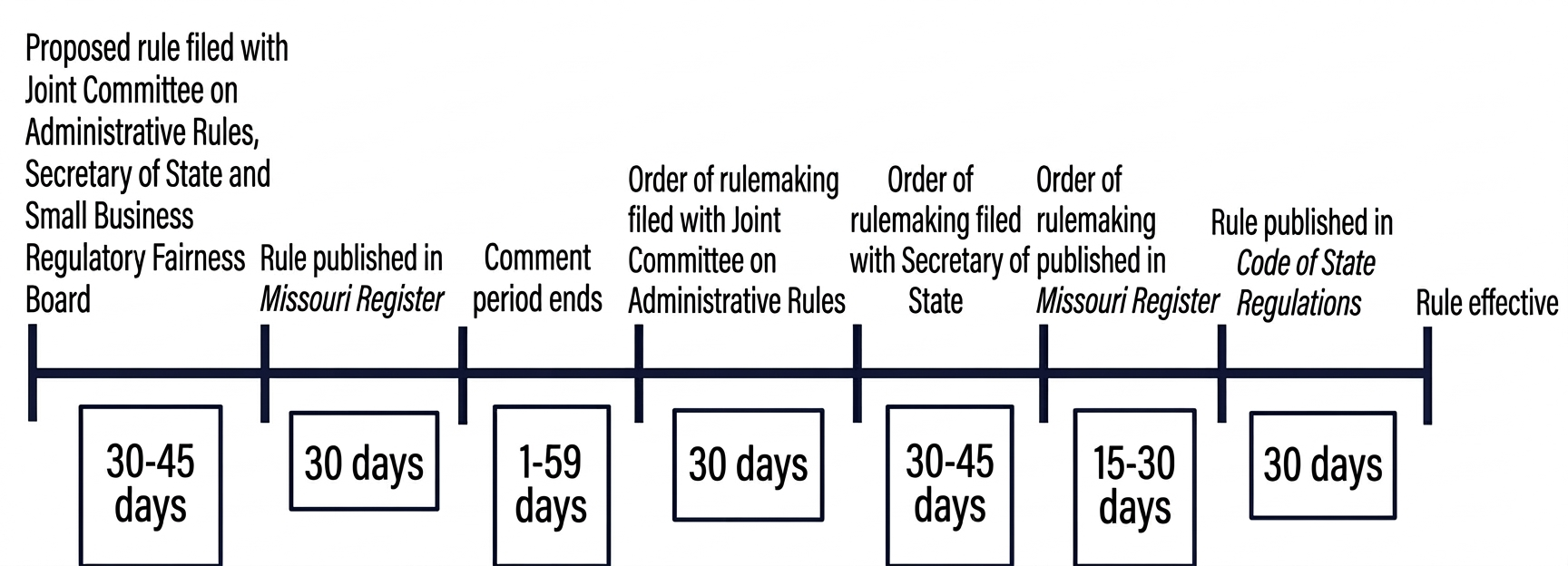
As shown in the timeline below, rules are initially printed in the Missouri Register, which is published twice a month. Once a rule has been published, a 30-day comment period begins during which any member of the public may provide comments to the agency promulgating the rule. The agency may also conduct a public hearing on the proposed rulemaking; the hearing date will be shown in the Missouri Register.
After the comment period, the agency compiles the comments received and any changes to the rule text in an Order of Rulemaking. The Order of Rulemaking is then filed with the Joint Committee on Administrative Rules and may not be filed with the Secretary of State until 30 days have elapsed.
Orders of Rulemaking currently under review by the Committee may be viewed using the link below. This report is updated each business day. The left column lists the filing date and rule number. The center column lists the rule title, and the date beneath the title is the deadline by which the Committee must take action to disapprove the rule.
Once the Order of Rulemaking has been on file with the Committee for 30 days, it is filed with the Secretary of State, who then publishes the Order of Rulemaking in the Missouri Register. The rule is then printed in the Code of State Regulations, which is published monthly. The rule goes into effect 30 days after publication in the Code of State Regulations.
The Committee may convene hearings on rules as it deems necessary, but generally holds hearings during the 30-day period in which the Order of Rulemaking is on file with the Committee. Typically the Committee will convene a hearing upon the request of any member of the Committee or upon the request of five members of the General Assembly. Citizens may also request the Committee to convene a hearing.
At a hearing, the Committee will hear testimony from those opposing the rule as well as those supporting the rule, including the state agency responsible for promulgating the rule. The Committee may take action on the rule and may disapprove the entire rule or any portion thereof.
If a rule has been disapproved by the Committee, it is held in abeyance and may not be published by the Secretary of State. For the Committee’s disapproval to become permanent, the General Assembly must ratify the action of the Joint Committee on Administrative Rules. This is achieved with passage of a concurrent resolution within 30 legislative days. Upon passage, the concurrent resolution is sent to the Governor for approval or rejection. If the concurrent resolution is endorsed by the Governor or the Governor’s veto has been overridden by the General Assembly, the rule is permanently disapproved.
The Committee also reviews rules for statutory fiscal note compliance. State agencies are required to file detailed fiscal notes for any proposed rulemaking that impacts public or private funds by more than $500, in the aggregate, over the life of the rule. In the past, the Committee has acted to disapprove rules which have not provided the public adequate notice regarding the public or private fiscal cost of a rulemaking.
In certain instances agencies may file emergency rules which may become effective no less than 10 days after filing and have a finite duration (180 calendar days or 30 legislative days, whichever is longer). The Committee’s review of these emergency rules is slightly different. The Committee must still review the emergency rules for compliance with statutes. However, the Committee does not have the power to disapprove the emergency rules. Rather, the Committee may provide comments and recommendations to the Secretary of State concerning the emergency rules. The Secretary of State is ultimately responsible to determine whether the emergency rules comply with the provisions of Chapter 536, RSMo.